Call us anytime +255 754 282 704
Let us plan your next adventure

Call us anytime +255 754 282 704

Let us plan your next adventure

Your Cart

Your cart is empty


Plan your Kenya Safari

Get essential trip information for your Kenya safari with Myriad Safaris - Attractions, health tips, packing lists, best time to visit, and more.

About Kenya


Kenya’s National Parks and Game Reserves offer exceptional game viewing and have the most diverse ecosystems - the semiarid desert regions, the lush Aberdare rainforest, Mount Kenya, the Savannas of the Maasai Mara, the acacia thorn scrub of Tsavo, the pink flamingos of the great rift valley lakes and the white sands and warm waters on the coast. 

There are schedule and charter flights to most areas, allowing guests easy access to remote and exclusive areas of wilderness. A wide range of accommodation is available, from permanent tented camps or lodges to private luxury mobile camp. 

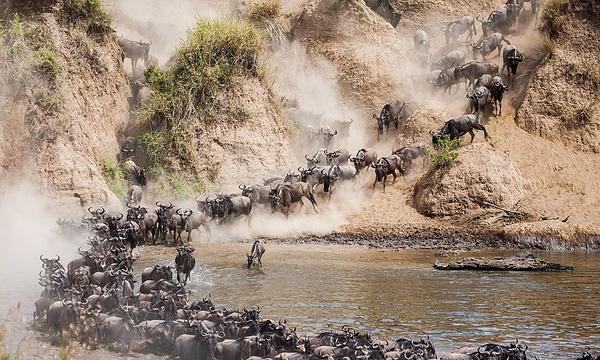
The great wildebeest migration, moves through Kenya (Maasai Mara) and Tanzania in a circular pattern throughout the year following the rain and in seek of greener pastures making it the most impressive displays of wildlife around the world. It’s Rift Valley, known as “the cradle of mankind,” is also where the discovery of humanoid skulls dating back tens of thousands of years have radically altered theories on the origin of mankind. One such archaeological find is estimated to be two and a half million years old! After centuries of occupation by the Portuguese, the Arabs, and the British, Kenya became an independent country in 1963. 


The cornerstone of Kenya’s capitalist economy is agriculture, which employs 80% of the people. Although coffee is the most widely cultivated commodity, Tourism and most recently, eco-tourism has replaced coffee as its largest source of foreign income. Distinctive mementos of the Safari country include Sisal baskets, batik prints on cotton, silk “kangas,” striped “kikois” (multi-purpose sarongs), soapstone carvings, and Makonde woodcarvings.

Kenya Highlights

AMBOSELI NATIONAL PARK

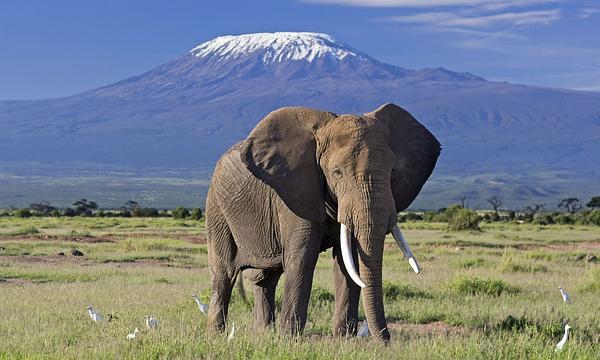
Amboseli National Park, at the foot of Africa’s highest mountain 5895m (19,340ft) Kilimanjaro is one of the most popular of all Kenya’s national parks. It lies some 240 kms (145 miles) south-east of Nairobi. The snow-capped peak of Mount Kilimanjaro rising above a saucer of clouds dominates every aspect of Amboseli National Park which covers 3,920 km (1513 square miles). The Tanzania border runs along its base and also forms the boundary of the park. The snows of Kilimanjaro, white and crystalline, also form a backdrop to one of Kenya’s most spectacular displays of wildlife - lion, elephant, leopard, rhino, cheetah, buffalo and hosts of plains game and the combination makes the park a photographer’s paradise. Part of the Park is composed of a dried-up lake bed which in the shimmering heat produces mirages. Swamps and springs, fed by underground rivers from Kilimanjaro’s melting snows, form permanent watering places for the wildlife in times of drought. Many attractive birds can be easily seen and equally easily photographed around the lodges. This is one of the few places where the rare and beautiful Taveta Golden Weaver is found.

MAASAI MARA GAME RESERVE

The jewel in Africa’s crown, Maasai Mara is host to the most spectacular array of wildlife. Her 320 square kilometers of open savannah, woodlands and tree-lined rivers creates an eco-system which supports huge numbers of bird and mammal species. The western border of the park is the spectacular Siria Escarpment, and together with the acacia dotted plains, creates scenery of stunning beauty. Lion are found in abundance throughout the park as are elephant, giraffe, a variety of gazelle species and zebra. Cheetah and leopard are also regularly seen and, if lucky, you may also find rhino. Game viewing is never dull in the Mara, and patience is often rewarded with unique sightings such as a pride of lion stalking their prey; a solitary leopard retrieving its kill from the high branches of an acacia tree; male wildebeest sparring to attract females into their harem; or even a herd of elephant protecting their young from opportunistic predators. 


The annual wildebeest migration traditionally is present in the Mara from July-September and at this time nature’s dramas unfold before your very eyes at every turn. As well as wildlife, the Maasai Mara is also home to many members of the colorful Maasai tribe who may be seen around the borders of the park - morans (warriors) loping across the plains, young boys herding goats, or elders grouped under a tree discussing matters of the day.

MOUNT KENYA

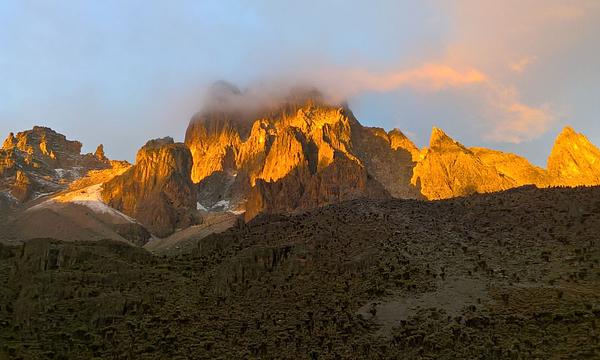
Mount Kenya is the county’s highest mountain. Sitting astride the equator its icy summit reaches to 5199m (17058 ft). All of the mountain above the 3200m (10500 ft) contour forms a national park. In fact the mountain consists of three principal zones; the rocky peak area, actually an eroded volcanic plug, with its cloak of glaciers and snow fields; the alpine zone with its distinctive giant vegetation; and the vast gentle slopes drenched in mountain forest and bamboo jungle.


It is no wonder that this remote majestic wonderland was considered as God’s domain by awed farmers at its foothills. Many rivers flow from the perpetual snows, among them the mighty Tana, source of much of Kenya’s electricity supply. Most visitors are content to marvel at the mountain’s beauty but some will want to attempt to reach the summits; a feat requiring considerable rock-climbing skill. But the mountain’s lesser peaks and glaciers can all be scaled and walked by the fit and the adventurous. Point Lenana, 4985 m (16355 ft) can be easily reached. 


Wildlife within the forests below the park boundary includes elephant, buffalo, lion, several species of antelope including the rare bongo and occasionally both melanistic leopard and serval. Much of this game can be seen from the comfort of Mountain Lodge which lies just inside the forest on the south side of the mountain.

LAKE NAKURU NATIONAL PARK

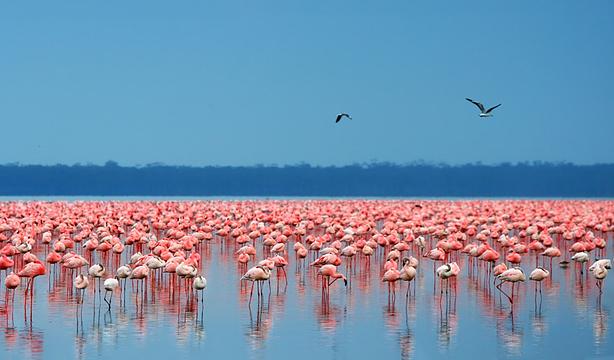
Lake Nakuru, a shallow and alkaline lake on the bed of the Great Rift Valley, has earned its fame as the home of the greatest bird spectacle in the world - flocks of often more than a million pink flamingos which seasonally use its waters to feed on the abundant algae which thrives in its shallow warm waters. It lies 156 kms (100 miles) from Nairobi by road.  Although the flamingo are the most obvious, other inhabitants of the alkaline lake include Black-winged stilts, avocets and in the European winter a mass of ruffs.  


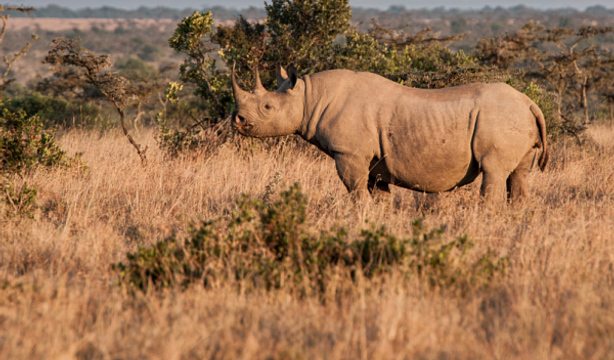
Lake Nakuru National Park has a great deal to offer. Besides its magnificent bird life, it is also a rhino sanctuary and one of the best places in the country to see both black and white rhino. The park is also host to lion, leopard, buffalo and a variety of plains and forest game which have made it their permanent and protected habitat. The acacia savannah which surrounds the lake is itself beautiful and provides an area which is particularly good for game viewing.

SAMBURU GAME RESERVE

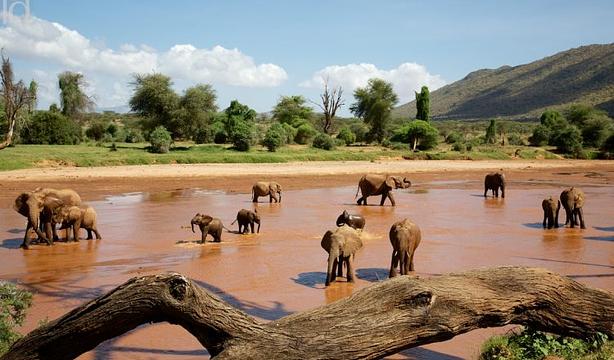
Samburu Game Reserve offers what is arguably Kenya’s greatest - and least changed - encounter with the wild Africa of yesteryear. This harsh, savagely beautiful wilderness depends on the steady flow of the Uaso Nyiro River for its existence; the river waters a wide variety of animal species not found south of the Equator, including the majestic Beisa oryx, the reticulated giraffe, the thin-striped Grevy’s zebra, and the ‘giraffe-necked’ gerenuk antelope, which stands on its hind legs to feed. Elephant, buffalo, lion and leopard can all be seen along the river, and the 400-plus species of birds are positively spectacular. Together with neighboring Buffalo Springs and Shaba national reserves, Samburu comprises 833 sq km of protected semi-desert land. This is the home of the Samburu tribe, cousins of the Maasai, who share the same nomadic, cattle-herding existence, and an even stricter adherence to their age-old rites and customs.

SWEETWATERS GAME RESERVE/ OL PEJETA RANCH

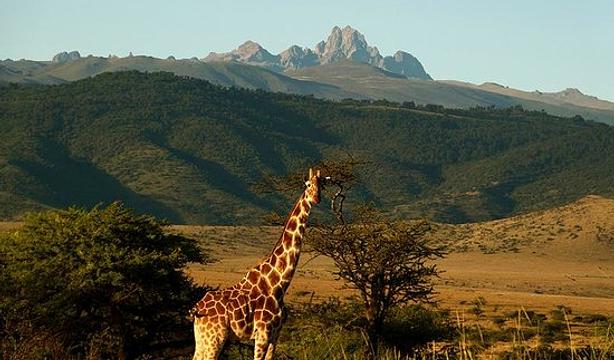
This renowned sweet waters Reserve is situated within the sprawling Ol Pejeta ranch with magnificent views across the plains to the peaks of Mount Kenya. A variety of plains game is found within the reserve and the big cats may also be seen. As sweet waters is a private reserve, it is possible for visitors to enjoy activities such as escorted bush walks, night game drives and camel riding. Orphaned rhino and warthog (one of which was the model for Pumba, from the movie the Lion King), which have been reared by hand, provide a wonderful treat for children, as does the chimpanzee sanctuary. The sanctuary homes chimps mainly from the Jane Goodall Institute in Tanzania, where a great many were placed after being rescued. The sanctuary is a non-profit venture, which aims not only to cover the investment and operating costs of the sanctuary, but also to channel funds into the Jane Goodall Institute for conservation projects for chimpanzees in the wild throughout Africa.

LEWA DOWNS CONSERVANCY

The Lewa Downs Conservancy is a 55,000-acre game-management project in the foothills of Mount Kenya where you can walk freely (accompanied by an armed escort), take a short safari on horse - or camelback, and enjoy both day and nighttime game drives.  Your private mobile camp is set in a secluded valley or next to a game-attracting spring where oryx, kudu, eland, rhino, and cheetah all become part of the Lewa Downs experience.


Explore Tours and Safaris, Activities and Accommodation options in Kenya